World Cup 2026
World Cup 2026: How AI Is Revolutionising the Beautiful Game
From AI-powered coaching tools and digital player avatars to autonomous vehicles and humanoid robots, the 2026 FIFA World Cup is the most technologically ambitious tournament in football history. Here is everything you need to know about how artificial intelligence is reshaping the game — on and off the pitch.
The Tournament That Changed Everything
The 2026 FIFA World Cup is not merely the largest football tournament ever staged. It is the first where artificial intelligence has been woven into the very fabric of competition — shaping how teams prepare, how referees decide, how stadiums operate, and how billions of fans experience the game. Co-hosted by Canada, Mexico, and the United States across 16 cities, the expanded 48-team, 104-match format has created a grand stage not only for elite football, but for a technological leap that will define the sport for decades to come.
Kicking off on June 11, the 2026 World Cup arrives at a moment of profound transformation. The data revolution that quietly began reshaping elite sport in the 2010s has accelerated into something altogether more ambitious: a real-time, AI-driven intelligence layer that covers everything from coaching analytics to referee assistance, from crowd safety to biometric monitoring of players during live matches. Welcome to football in the age of artificial intelligence.
A Level Playing Field — Finally
To understand the magnitude of this shift, it helps to understand how unequal football's technological landscape has historically been. Before 2018, FIFA provided no shared analytics infrastructure whatsoever to competing nations. The consequence was stark: federations with deep financial resources — England, Germany, France — could invest in proprietary data systems, dedicated video analysis departments, and specialist performance scientists. Smaller nations simply could not compete on this dimension, regardless of the quality of their playing squad.
Post-2018, the situation improved incrementally. VAR arrived in Russia, bringing semi-automated video review of key incidents. Goal-line technology became standard. The Semi-Automated Offside system (SAO) debuted at the 2022 World Cup in Qatar. Each innovation moved the game forward, but none addressed the fundamental asymmetry in how nations could access, analyse, and act upon data.
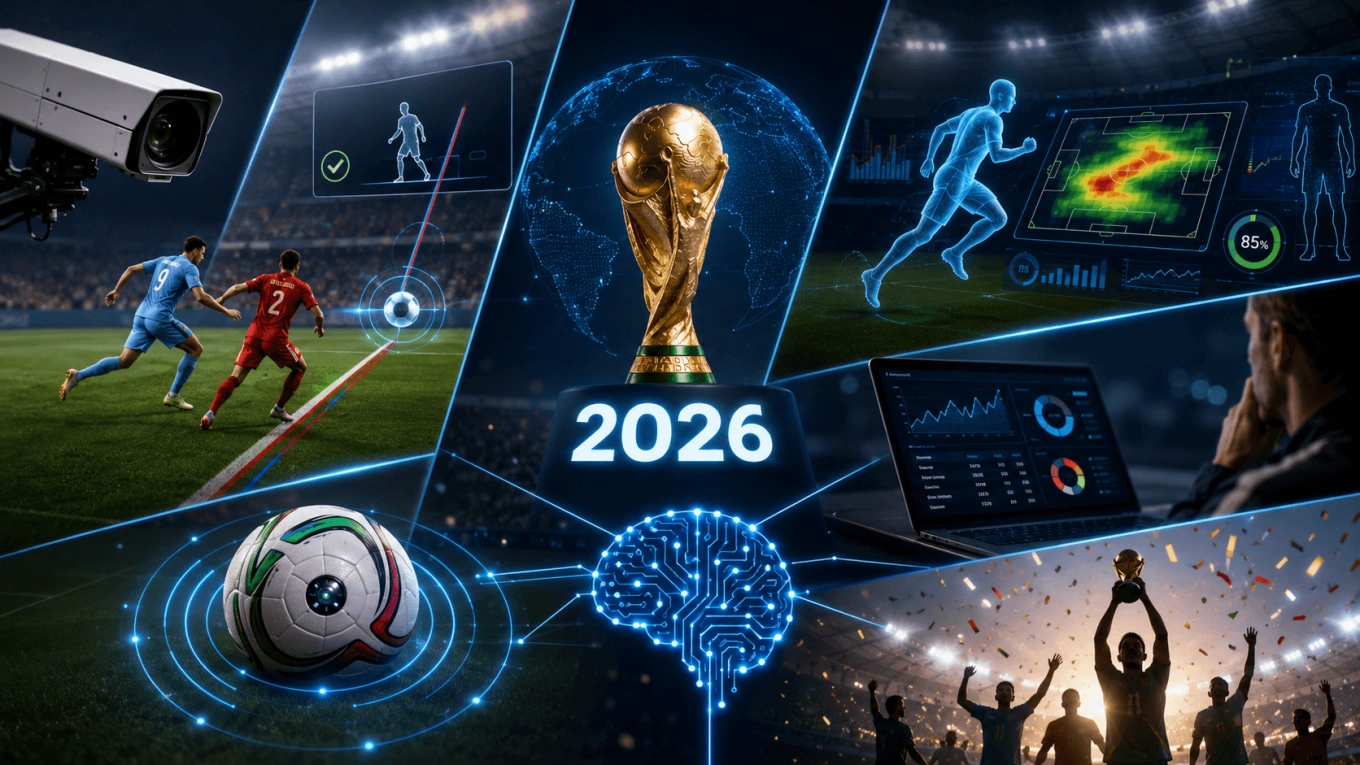
In 2026, that changes entirely. Every participating nation will receive access to the same AI-driven platform — a system developed by Lenovo under the name Football AI Pro (also referred to as FIFA AI Pro). The platform can process over 2,000 football-specific metrics — pressing intensity, player movement patterns, tactical transitions, defensive shape, set-piece tendencies — and analyse hundreds of millions of FIFA data points simultaneously.
Coaches receive tactical breakdowns in a format of their choosing: structured text summaries, interactive charts, or short-form video clips. Players receive personalised post-match performance reports calibrated to their individual role. Analysts can simulate upcoming opponents' defensive structures and test tactical variations in real-time 3D environments. The system, in short, offers every nation something that previously only the wealthiest could afford to build themselves.
As Bank of America Global Research noted: "Previously, wealthy teams often had the technology edge. In 2026, AI is democratising data — and levelling the playing field."
Digital Avatars: When Every Player Gets a Twin
One of the most striking technological innovations at the 2026 World Cup operates before a ball has even been kicked. According to FIFA, every player at the tournament will be scanned within approximately one second to generate a precise three-dimensional digital avatar of their body — a geometrically accurate virtual representation that captures skeletal structure, limb proportions, and physical dimensions to a degree of precision previously impossible at this scale.
The primary application of these avatars is in offside decision-making. For years, VAR's offside rulings — while more accurate than the human eye — remained difficult to explain clearly to fans and occasionally generated controversy over the use of projected lines and timing thresholds. Digital avatars eliminate much of this ambiguity. By creating a 3D model of each player's body in real time, the system can determine with far greater precision exactly where any given body part is positioned relative to the last defender at the moment a pass is played.
The downstream benefits extend beyond accuracy. Broadcasters will have access to visually compelling 3D reconstructions of offside calls, making it easier than ever to explain complex decisions to a global audience. Referees themselves will have clearer visual confirmation before communicating rulings. And the VAR process, which has attracted criticism for its perceived opacity, will become substantially more transparent — a significant step for the credibility of the game at its highest level.
Edge Computing: Bringing the AI Closer to the Pitch
The refereeing ecosystem at the 2026 World Cup has undergone its most substantial technological overhaul in the tournament's history. Both VAR and the Semi-Automated Offside system have been migrated away from traditional cloud infrastructure and onto edge computing architectures — a change that sounds technical but carries profound practical consequences.
In a conventional cloud setup, data from cameras and sensors at a stadium is transmitted to remote data centres, processed, and returned as a result. This round-trip introduces latency — measurable delays that, in time-sensitive refereeing contexts, can matter. It also introduces dependency on network connectivity and creates potential points of failure that stadium-level incidents (power issues, bandwidth congestion) can exacerbate.
Edge computing inverts this model. Data from hundreds — potentially thousands — of cameras and sensors distributed across each of the 16 host stadiums is now processed locally, on-site, on hardware installed at the venue itself. The result is dramatically reduced latency, greater system resilience, and faster AI-assisted verdicts on contested incidents involving handball, offside, dangerous play, and other VAR-reviewable situations.
Critically, AI's role in VAR has also been expanded. Rather than simply replaying video footage for referees to review, the system now actively intervenes to identify and flag the specific elements most likely to have caused a contentious decision — player positions, ball trajectory, point of contact — by analysing real-time positional data alongside video. The referee is no longer watching footage in isolation; they are receiving a structured, AI-curated breakdown of the incident.
Hawk-Eye Elevated: The Eyes of the Tournament
Among the technologies most visibly transformed by the shift to edge computing is Hawk-Eye — the multi-camera ball and player tracking system that has become synonymous with precision officiating across multiple sports. At the 2026 World Cup, Hawk-Eye operates with substantially greater processing capacity than at any previous tournament, enabling real-time 3D reconstruction of ball trajectories and simultaneous tracking of every player on the pitch.
The system works by cross-referencing footage from multiple high-speed cameras positioned throughout the stadium, triangulating position data into continuous three-dimensional models of both the ball and all 22 outfield players. At the 2026 World Cup, this data feeds simultaneously into the refereeing support system, the broadcast graphics pipeline, and the team analytics platform — creating a unified data layer that connects officials, coaches, and viewers in real time.
For supporters watching on broadcast, the improved Hawk-Eye infrastructure will deliver richer, more visually compelling graphics: real-time speed readings, distance covered, expected goal visualisations, and ball-flight reconstructions that were previously only available as post-match statistics. Football has always been a sport of opinions and arguments. In 2026, those arguments will be conducted with considerably more data.
The Living Stadium: Digital Twins and Real-Time Operations
All 16 host venues at the 2026 World Cup will operate alongside a real-time digital twin — a continuously synchronised virtual replica of the physical stadium that mirrors events inside the ground as they happen. The concept, borrowed from industrial engineering and infrastructure management, represents a significant expansion of how major sporting venues can be managed during live events.
Stadium operators will use these digital twins to monitor crowd density and movement patterns across all sections of the ground, identifying potential bottlenecks or security concerns before they escalate. Emergency services and security teams will have access to a dynamic, real-time model of crowd distribution — a capability that could prove invaluable in the event of an incident requiring rapid response. Venue logistics teams will use the same data to optimise concession flows, transportation scheduling, and post-match egress planning in ways that have previously relied on educated guesswork.
For the players on the pitch, a parallel data layer operates via wearable technology. Each player's biometric data — heart rate, acceleration, deceleration load, distance covered — is synchronised in real time, allowing team medical staff to detect early warning signs of physical stress, fatigue-related injury risk, or cardiovascular anomalies during live matches. A coach's substitution decision in 2026 may be informed not only by what they see on the pitch, but by what the data is quietly indicating about a player's physiological state.
An Unprecedented Data Deluge
The cumulative scale of data that the 2026 World Cup will generate is almost difficult to conceptualise. SanDisk estimates the tournament will produce more than 90 petabytes of data — 45 times the volume generated during the 2022 World Cup in Qatar. When social media activity, mobile device interaction, streaming platform engagement, and broader digital consumption are factored in, Bank of America's research team projects a total approaching two exabytes — equivalent to approximately 45,000 years of continuous 4K video playback.
To frame that differently: the 2022 World Cup, itself already the most-watched sporting event in television history, generated around two petabytes of core tournament data. The 2026 edition is expected to produce forty-five times that volume from the tournament itself alone, before a single social media post or streaming interaction is counted.
"This is the first football tournament where data is itself a primary product," BofA's analysts noted in a briefing to the South China Morning Post. "We are witnessing large-scale real-time simulation, where the physical world is being mirrored in data at a rate of several petabytes per week." It is a formulation that would have seemed fanciful a decade ago. In 2026, it is simply the operational reality of hosting the world's most-watched sporting event.
Autonomous Vehicles: The World Cup's Most Ambitious Mobility Experiment
The technological ambitions of the 2026 World Cup extend well beyond the boundaries of each stadium. In what organisers are billing as the largest autonomous vehicle deployment at any sporting event in history, seven self-driving car companies will operate services across 10 of the tournament's host cities — offering fans a genuine robotaxi alternative to conventional transport for the duration of the tournament.
Waymo leads the deployment, with planned services across seven host cities and pilot trials extending to three additional US venues. The scale of Waymo's presence reflects both the company's operational maturity — its driverless service in San Francisco and Phoenix has now logged millions of passenger miles — and the tournament's ambition to present AI-powered mobility as a mainstream rather than experimental proposition.
For visiting fans, the autonomous vehicle fleet will offer a glimpse of a near future in which the choice between taxi and robotaxi is as unremarkable as choosing between cash and contactless payment. Whether that vision survives contact with the chaotic logistics of a 48-team World Cup spread across three countries remains one of the tournament's most fascinating subplots.
Robots on the Pitch: Atlas, Spot, and the Future of Stadium Operations
Humanoid and quadruped robots will make their World Cup debut in 2026 — and their presence signals something more than a promotional stunt. Hyundai, the South Korean automotive and robotics conglomerate that owns Boston Dynamics, will deploy two of the company's most advanced platforms across host venues: Atlas, the bipedal humanoid robot capable of dynamic locomotion and manipulation tasks, and Spot, the four-legged robot dog that has already found commercial applications in inspection, security, and emergency response.
At the World Cup, both platforms will be deployed in operational and fan-facing roles — supporting logistics, assisting with wayfinding, and enabling the kind of interactive fan experiences that have become an increasingly important dimension of major sporting events in the social media era. For Hyundai and Boston Dynamics, the tournament represents an extraordinary showcase: 48 nations, 104 matches, and a global broadcast audience measured in the billions.
Mexico has separately announced plans to deploy robot dogs for stadium security and emergency response operations during matches played on its soil — a deployment that carries more operational than promotional intent, and which will be watched closely by security professionals and event organisers worldwide.
AI in the Dugout: The Coaching Revolution Beyond 2026
The AI integration at the 2026 World Cup does not exist in isolation. It reflects and accelerates a broader transformation already underway in professional sport — one in which AI moves from analytical support tool to active participant in real-time decision-making.
Earlier in 2026, the Oakland Ballers became the first professional sports team to deploy AI in live in-game management decisions, including lineup selection and substitution timing during actual matches. Norwegian football club HamKam FC ran a parallel experiment, with AI-generated tactical recommendations informing coaching decisions in real time. Neither experiment produced conclusive results — but both demonstrated that the boundary between human and machine decision-making in elite sport is actively being tested.
At the World Cup level, FIFA AI Pro stops short of making decisions. Its role is to present information — to surface patterns, flag anomalies, and model scenarios that would take human analysts far longer to identify. The coach retains full authority. But the information environment in which that authority is exercised will be richer, faster, and more comprehensive than at any previous tournament.
As consulting firm PwC observed in a January 2026 report: "The goal is not to replace the roar of the crowd or the instinct of a great coach. Instead, this technology helps everyone focus on what they do best: inspire, lead, and connect. AI does not destroy the magic of sport — it amplifies it."
What This Means for the Game Itself
The question that underpins all of this — and that will be debated with particular intensity over the course of 104 matches — is deceptively simple: does it make the football better?
The honest answer is that it depends on what you value. For coaches and analysts, the democratisation of data is an unqualified positive. Nations that previously lacked the resources to build world-class analytics departments will arrive in North America with access to the same AI tools as the tournament favourites. The playing field is not entirely level — squad quality, experience, and financial depth still matter enormously — but the analytical gap between football's haves and have-nots has narrowed in ways that could produce genuine surprises over the course of the tournament.
For fans, the improvements to officiating transparency are broadly welcome, though the lingering concern among purists — that VAR, however technically improved, fundamentally disrupts the emotional rhythm of the game — will not disappear simply because the technology has become more sophisticated.
For the players themselves, the experience of being continuously tracked, biometrically monitored, and analytically dissected in real time raises questions about privacy, autonomy, and the increasingly fine line between performance support and surveillance. These are conversations that football, like every elite sport, will need to continue having as the technology evolves.
What is beyond dispute is that the 2026 World Cup represents a before-and-after moment in football's technological history. When the final whistle sounds in the summer of 2026, the sport will look back at this tournament — held across the vast stadiums of North America, watched by a global audience in the billions — as the point at which artificial intelligence became not just a tool used in football, but a defining presence within it.
Stay tuned to TuringStats for AI-driven match previews, group-stage analysis, player performance breakdowns, and real-time probability updates throughout the 2026 FIFA World Cup.