AI Forecasts
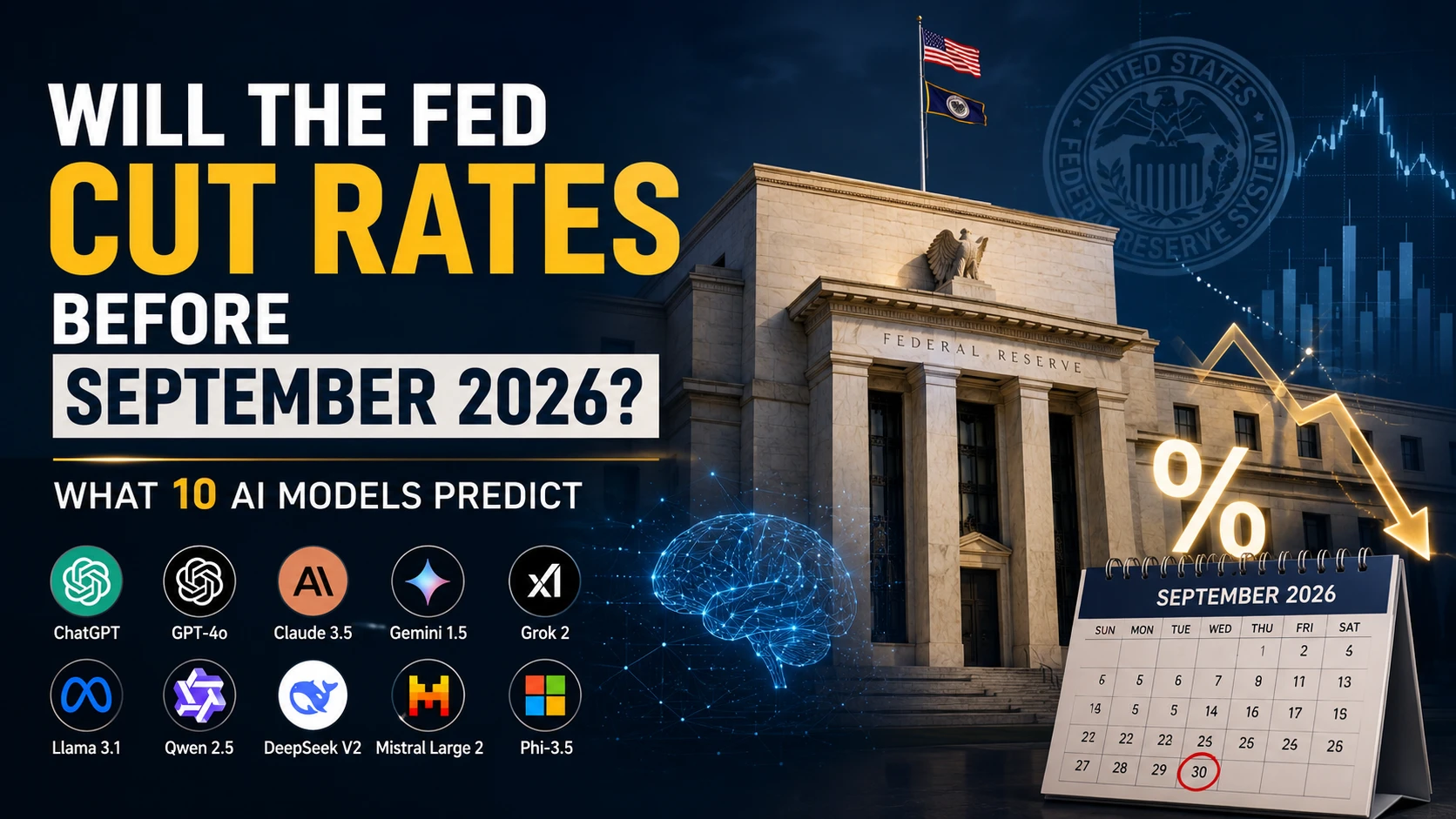
Will the Fed Cut Rates Before September 2026? What 10 AI Models Predict
Ten leading AI models — including GPT-4o, Claude, Gemini, and Mistral — weighed in on one of Wall Street's most pressing questions: Will the Federal Reserve cut interest rates before September 2026? The verdict: 6 say yes, 4 say no. Here's what their reasoning reveals about the economic road ahead.
The Question That Has Wall Street on Edge
In the high-stakes arena of monetary policy, few questions carry more weight than this: Will the Federal Reserve cut interest rates before September 2026? It's a question that determines mortgage rates, business investment decisions, stock market valuations, and the financial wellbeing of millions of Americans.
To find answers, TuringStats convened a council of ten of the world's most advanced artificial intelligence models — GPT-4o, Claude Sonnet, Gemini 3.1 Pro Preview, Mistral Large, DeepSeek Chat, Qwen 2.5, Llama 3.1, MiMo, Cohere Command R+, and Grok — and asked them to deliberate on this single, consequential question. The result: a 6-to-4 majority verdict in favor of YES, the Fed will cut rates before September 2026.
But the real story isn't just in the vote count. It's in the sophisticated, sometimes conflicting reasoning that emerges when the world's top AI systems analyze the same economic landscape — and reach different conclusions.
The Macro Backdrop: A Fed Caught Between Two Fires
To understand why this question is so contested, you need to understand where the Federal Reserve stands today. After an aggressive rate-hiking cycle that began in March 2022 — the fastest tightening campaign since the 1980s — the Fed raised the federal funds rate from near-zero to a target range of 5.25%-5.50%, a 23-year high. The mission was singular: crush inflation that had surged to 9.1% in June 2022, the highest level since 1981.
The strategy worked — eventually. By late 2023 and into 2024, inflation began its slow retreat toward the Fed's 2% target. That progress opened the door for the Fed to begin what economists call an "easing cycle." In September 2024, the Federal Reserve made its first rate cut in four years, reducing rates by 50 basis points. Two additional 25-basis-point cuts followed before the end of 2024, bringing the target range down to 4.25%-4.50%.
But then — the Fed paused. And that pause is precisely what makes the September 2026 question so combustible.
What the AI Council Said: A Breakdown of 10 Expert Opinions
Here's where the analysis gets genuinely fascinating. TuringStats didn't just poll AI models for a yes/no answer — it asked them to reason through the evidence and defend their positions. The result is a microcosm of the debate currently raging in financial markets.
The YES Camp: Six Models Betting on Easing
GPT-4o anchored its bullish case on historical precedent, noting that "economic cycles typically involve periods of both rate increases and cuts," and that a cut within a multi-year window is not just plausible — it's expected. The model highlighted that unforeseen economic challenges or slowdowns could accelerate the Fed's hand.
Claude Sonnet offered perhaps the most data-anchored argument, pointing out that "the Fed already began cutting rates in late 2024" and that with the fed funds rate "still well above the long-run neutral estimate, there is significant room and motive to ease further." Claude calculated the probability of at least one additional cut before September 2026 at "comfortably above 70%," citing the historical pattern that the Fed "rarely holds rates at a plateau for more than 18 months once an easing cycle begins."
Gemini 3.1 Pro Preview struck the most confident tone of any model, calling a rate cut before September 2026 "undoubted," and pointing to two converging forces: cooling inflation giving policymakers "the runway they need to ease," and a softening labor market that would "force" the central bank to lower borrowing costs to prevent an unnecessary recession.
Mistral Large also voted yes, emphasizing that cooling inflation toward the 2% target, combined with softening wage growth, would support "a shift toward accommodation." Mistral flagged the Fed's dual mandate — price stability and maximum employment — as the structural driver behind any future cuts.
Llama 3.1 70B focused on the recession risk angle, suggesting that if economic conditions deteriorate, the Fed's historical reflexes would kick in: "The Fed has a history of cutting rates in response to economic downturns." Llama also cited "global economic uncertainty" as a wildcard that could force the Fed's hand ahead of schedule.
Grok 4.3 took a pragmatic, cycle-based view: "Rate adjustments occur in nearly every economic cycle, and the current level leaves ample room for easing when conditions warrant." It noted that the Fed "rarely maintains a static stance across 18-24 months without at least one cut" — a statistical argument as much as an economic one.
The NO Camp: Four Models Standing Firm
DeepSeek Chat made the contrarian case that inflationary pressures "remain persistent," requiring the Fed to keep rates elevated. Crucially, DeepSeek pointed to labor market resilience as removing the pressure for cuts — if unemployment stays low and workers remain employed, the Fed has less reason to stimulate the economy.
Qwen 2.5 72B Instruct argued that the Fed remains "focused on maintaining or gradually raising interest rates to combat inflation," suggesting that the path of least resistance might actually be upward, not downward — a view that aligns with some of the more hawkish voices on the Federal Open Market Committee (FOMC).
MiMo V2.5 Pro offered the most nuanced "no" argument, pointing to the "persistent uncertainty around tariffs and fiscal policy" as wildcards that could reignite inflation. With the labor market "relatively solid," MiMo concluded that "current economic momentum suggests the Fed will hold steady well into 2026 rather than act before September."
Cohere Command R+ also landed in the no camp, suggesting that "inflation remaining elevated" means the Fed is "more likely to maintain or even raise rates." Cohere pointed to the Fed's own communications as a signal that policymakers are not yet ready to declare victory over inflation.
The Economic Fault Lines: What the Models Are Really Arguing About
Strip away the individual model opinions, and a clear set of fault lines emerges. This isn't a random disagreement — it's a structured debate about which economic signals matter most.
The first fault line is inflation trajectory. The yes camp argues that disinflation is well underway and that the Fed will have both the cover and the incentive to cut. The no camp counters that inflation remains "sticky" — particularly in services — and that premature easing could reignite the very problem the Fed spent two years fighting.
The second fault line is labor market interpretation. Interestingly, the two camps read the same data in opposite ways. The yes models (like Gemini and Mistral) see a softening labor market as a catalyst for cuts. The no models (like DeepSeek and MiMo) see a resilient labor market as a reason the Fed doesn't need to cut — and can afford to stay restrictive.
The third fault line is the neutral rate question. Claude Sonnet highlighted that rates remain "well above the long-run neutral estimate." This matters enormously: if the neutral rate — the rate that neither stimulates nor restricts growth — is around 2.5-3%, then today's rates at 4.25-4.50% are genuinely restrictive and create their own economic drag over time.
The fourth fault line is external shocks. MiMo raised tariffs and fiscal policy as underappreciated risks. With significant trade policy uncertainty in 2025 and 2026, there's a real possibility that inflationary pressures could resurface from external sources — supply chain disruptions, commodity price spikes, or new geopolitical tensions — that have nothing to do with domestic monetary policy.
What Markets Are Pricing In: The Futures Tell a Different Story
Federal funds futures markets — where professional traders bet real money on the Fed's policy path — have been the most accurate predictor of Fed decisions over historical cycles. As of mid-2026, market pricing generally reflects expectations for gradual easing, broadly consistent with the 60% majority in the AI council voting yes.
The Fed's own Summary of Economic Projections (the "dot plot") has historically provided the most direct window into policymakers' thinking. The challenge is that dot plots are snapshots, not commitments — and the economic data between now and September 2026 will update many times over, shifting the consensus accordingly.
What's clear is that markets are not pricing in rate hikes. The debate is entirely about the pace and timing of cuts, not the direction. This itself is significant: even the most hawkish scenario being priced in by sophisticated institutional investors involves holding rates steady, not raising them.

The Historical Pattern: What 75 Years of Fed Cycles Tell Us
History is on the side of the yes camp — with important caveats. Looking at every Federal Reserve tightening cycle since the 1950s, the average time between the final rate hike and the first rate cut has been approximately 7-10 months. By that measure, and with the easing cycle having begun in late 2024, September 2026 represents an extraordinarily long holding period.
But history also shows that the Fed's behavior is deeply context-dependent. The 1970s demonstrated the catastrophic consequences of cutting rates prematurely — twice. The Fed cut in 1974 and 1980 before inflation was truly contained, only to see it surge back, forcing even more aggressive tightening that ultimately caused severe recessions. This "stop-go" policy failure is etched into the institutional memory of every Fed governor who has served since Paul Volcker's tenure.
Jerome Powell has explicitly invoked this lesson. The Fed under his leadership has repeatedly emphasized that it will not repeat the mistakes of the 1970s — and that means being willing to hold rates at restrictive levels longer than the market wants, if that's what it takes to ensure inflation is sustainably at 2%.
The Tariff Wildcard: The Variable No Model Can Fully Price
Perhaps the most significant uncertainty hanging over the 2026 rate outlook is trade policy. The imposition of broad tariffs — particularly on goods from major trading partners — creates a uniquely challenging scenario for the Fed. Tariffs are inflationary in the short term (they raise prices for imported goods) but potentially disinflationary in the medium term (if they slow economic activity enough to reduce overall demand).
This creates a genuine dilemma for monetary policy. If the Fed cuts rates into a tariff-induced price shock, it risks appearing to accommodate inflation. If it holds rates high while tariffs slow the economy, it risks engineering an unnecessary recession. MiMo's analysis, which specifically flagged tariff uncertainty as a reason to hold rates, reflects a sophisticated reading of this problem.
The AI models in the yes camp, by contrast, largely treated tariff risks as manageable or already priced in — a difference in risk weighting that explains much of the 6-4 split.
What "Before September 2026" Actually Means
It's worth pausing to consider what the question is actually asking. A cut before September 2026 could mean anything from one 25-basis-point cut that brings rates from 4.25%-4.50% to 4.00%-4.25%, to a series of aggressive cuts that take rates down to 2.5% or below in response to a recession. The AI models largely interpreted the question as asking about any cut — and most agree that the bar for at least one additional cut before that date is relatively low.
The more interesting question, arguably, is what kind of cut is coming. A "soft landing" scenario — in which the Fed cuts gradually as inflation normalizes without a recession — would likely involve one or two additional 25-basis-point cuts. A "hard landing" scenario — in which the economy slips into recession — could see the Fed cut aggressively, potentially 200-300 basis points or more, as it did in 2001 and 2008.
The yes camp's models are broadly pricing in the soft-landing scenario. The no camp's models are either pricing in a "no landing" scenario (economy remains too hot to cut) or are skeptical that conditions will shift enough to justify even a single cut.
The AI Consensus vs. Human Expert Consensus
One of the most valuable aspects of the TuringStats deliberation format is the ability to compare AI consensus with human expert consensus. In this case, the 60% yes vote from AI models broadly aligns with mainstream economist forecasts, which as of mid-2026 also lean toward expecting at least one additional Fed cut before year-end.
But there's a crucial difference in how AI models and human analysts approach uncertainty. Human economists often anchor too heavily on recent data and struggle with the psychological difficulty of changing their minds once they've published a forecast. AI models, by contrast, apply probabilistic reasoning across a broader range of scenarios and are less subject to career-risk incentives that might cause analysts to stick with consensus views even as data evolves.
The four dissenting models in the TuringStats council represent a meaningful minority view — one that institutional investors would be unwise to ignore entirely. In financial markets, being right 60% of the time still means being wrong 40% of the time. The no camp's concerns about sticky inflation, tariff risks, and labor market resilience are not fringe views — they represent the considered position of some of the world's most sophisticated language models.
Investment Implications: What This Means for Your Portfolio
For investors, the implications of the AI council's verdict extend across asset classes. A yes outcome — rate cuts before September 2026 — would generally be positive for fixed-income assets (bond prices rise as yields fall), supportive for high-dividend equities, and bullish for rate-sensitive sectors like real estate and utilities. A no outcome would sustain pressure on long-duration bonds and could weigh on growth stocks that depend on low discount rates.
Perhaps more importantly, the uncertainty itself has investment implications. When there's genuine disagreement among sophisticated analysts — whether human or AI — it typically means that markets haven't fully priced in all scenarios. This can create opportunities for investors who correctly identify which scenario is more likely to materialize.
The 6-4 AI vote is itself a signal: it's not a landslide. The market shouldn't be treated as a certainty in either direction, and portfolio construction should account for both scenarios.
The Bigger Picture: Why AI Deliberation Matters for Economic Forecasting
The TuringStats approach — asking multiple AI models to independently deliberate on a single question and then aggregating their reasoning — represents a genuinely new methodology in economic forecasting. Traditional forecasting relies on individual analysts or small teams, subject to groupthink, institutional bias, and career incentives. The AI council approach generates intellectual diversity by design.
The 10-model deliberation on Fed rate cuts demonstrates both the power and the limits of this approach. The power: each model brings a distinct analytical framework to the same question, surfacing arguments that a single analyst might miss. The limits: AI models, like human analysts, are constrained by their training data and may share systematic biases in how they interpret economic information.
What's clear is that the question of Federal Reserve rate cuts before September 2026 is genuinely uncertain — and that uncertainty is valuable information in itself. Markets that treat the outcome as a foregone conclusion in either direction are almost certainly mispricing risk.
Conclusion: The Verdict Is In, But the Story Isn't Over
Ten of the world's most advanced AI models deliberated on one of the most consequential questions in global finance — and reached a 6-4 majority verdict: Yes, the Federal Reserve will cut rates before September 2026.
But the four dissenting voices are not noise. They represent a coherent, evidence-based case that inflationary pressures remain too persistent, labor markets too resilient, and policy uncertainty too elevated to justify easing. In a world where the Fed's own dot plot is revised every quarter and economic data surprises constantly, the minority view deserves serious weight.
What the AI council makes clear, above all, is this: the path of monetary policy over the next 15 months will be determined not by any single variable, but by the complex interplay of inflation data, employment trends, global trade conditions, and the Fed's own evolving risk assessment. The models that got it right will be those that weighted these factors most accurately — and we won't know the final answer until September 2026 arrives.
Until then, the debate — human and artificial — continues.